What Is Imposition Writing? A Guide for Pupils and Parents
Imposition writing, usually called “lines”, means copying the same sentence out by hand many times as a school sanction. This guide explains how long lines take, how to finish them neatly without an aching hand, and what parents need to know about the rules.
What is imposition writing?
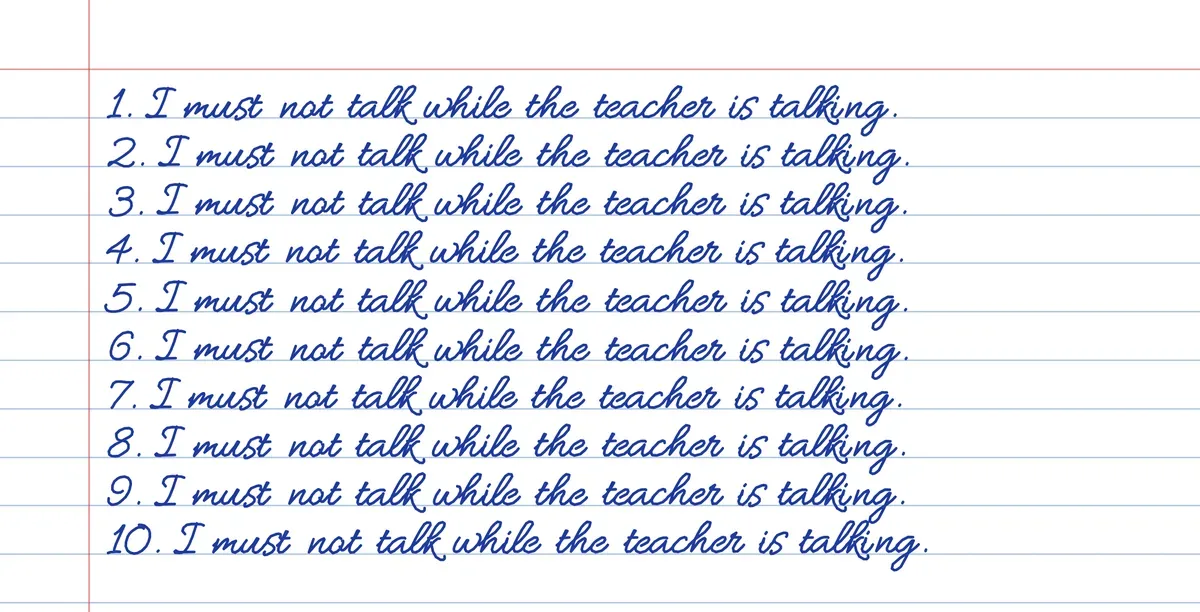
An imposition is extra written work that a teacher sets as a sanction. The most common kind is writing lines: the teacher gives you a sentence linked to what went wrong and tells you how many times to copy it out. Typical sentences include:
- I must not talk while the teacher is talking.
- I will hand my homework in on time.
- I must not use my phone in lessons.
You may also hear impositions called “lines” or “impots”, an old school slang word. Some teachers set a different written task instead, such as copying out a page of text or writing an account of what happened.
Why do UK schools still set lines?
Lines have outlasted most old-fashioned school punishments for practical reasons:
- They need no supervision. Pupils do them at home, so no member of staff has to stay behind as they would for a detention.
- They take time. Schools hope that losing an evening to copying puts pupils off repeating the behaviour.
- They link the sanction to the rule. The sentence names the behaviour the school expects.
Lines are less common than they used to be. In 2014, the Department for Education’s behaviour advice for schools named “writing lines or an essay” as an example sanction. Its current guidance, published in February 2024, refers instead to “the setting of written tasks such as an account of their behaviour”. Some teachers also argue that using writing as a punishment puts pupils off writing, so practice varies from school to school.
Are schools allowed to set lines?
In England, yes. The Education and Inspections Act 2006 lets schools sanction pupils as long as the sanction is reasonable in all the circumstances. Staff must consider whether it’s proportionate and take account of the pupil’s age, any special educational needs or disability, and any religious requirements.
In practice, this means:
- each school sets out its sanctions in a behaviour policy, which is usually on its website
- the amount of work should match what happened
- a pupil with dyspraxia, dysgraphia or another condition that makes handwriting hard may need a different task
Scotland, Wales and Northern Ireland have their own rules, so check your school’s behaviour policy wherever you are.
How long do lines take?
It depends on the length of the sentence and how fast you write. A US study of handwriting speed (Graham and colleagues, 1998) found that pupils of secondary school age copy at about 17 to 24 words a minute when asked to write quickly without mistakes. Most people slow down during a long session, so plan for the lower end.
This table shows rough times for a nine-word sentence such as I must not talk while the teacher is talking, without breaks.
| Lines | Words to write | At 15 words a minute | At 25 words a minute |
|---|---|---|---|
| 50 | 450 | 30 minutes | 18 minutes |
| 100 | 900 | 1 hour | 36 minutes |
| 200 | 1,800 | 2 hours | 1 hour 12 minutes |
| 500 | 4,500 | 5 hours | 3 hours |
Add about five minutes of breaks for every half hour of writing. If you have 200 lines or more and the deadline allows, split them across two evenings.
How to write lines faster and more neatly
1. Check exactly what you have to do
Before you start, make sure you know the exact wording, how many lines to write, whether to number them, what paper and pen to use and when to hand them in. Teachers can reject lines with the wrong wording or a missing word, so write the sentence on a sticky note and keep it in view.
2. Set up your desk
Clear the desk, sit with your feet flat on the floor and rest your forearm on the table. Tilt the paper slightly: to the left if you write with your right hand, or to the right if you’re left-handed. Put your phone in another room.
3. Choose a pen that writes smoothly
A 0.5 to 0.7 mm gel pen or rollerball needs less pressure than a cheap ballpoint, so your hand tires more slowly. Use black or blue ink unless your teacher has asked for something else, and only use pencil if you’ve been told to.
4. Write whole lines, not columns
Some pupils write the first word all the way down the page, then the second word, and so on. It feels faster, but the words rarely line up, and many teachers spot it at once and set the lines again. Write each sentence in full, from start to finish.
5. Count in tens
Number your lines if your teacher asks you to. If not, put a small tick in the margin after every ten lines so you never lose count. Working in blocks of ten also makes a long task easier to face.
6. Relax your grip and take breaks
Most hand ache comes from squeezing the pen. Hold it lightly, about 2 to 3 cm from the tip, and let your whole arm move across the page rather than just your fingers. Every 15 to 20 minutes, stop for a minute: shake out your hand, spread your fingers wide and make a loose fist a few times.
7. Keep it neat to the last line
Teachers often hand back lines that start neatly and end as a scrawl. Keep your letters the same size, sit them on the line and leave a finger space between words. If your writing starts to slip, slow down for a couple of lines.
What not to do
- Don’t print or type them. If your teacher asked for handwritten lines, printed pages, handwriting fonts and photocopies won’t count.
- Don’t ask someone else to write them. Teachers know their pupils’ handwriting.
- Don’t fake them with an app or a handwriting robot. If you’re caught, you’ll probably face a bigger sanction than the original lines.
- Don’t leave them until the night before. As the table shows, 200 lines can take two hours.
Advice for parents
Lines can cause stress at home, especially when the number is large or the deadline is tight. You can help by:
- reading the school’s behaviour policy, so you know what the sanction is for
- helping your child plan their time, as several short sessions work better than one long one
- checking the first few lines, so the wording is right before they write the rest
Contact the school if the amount seems out of proportion, if the deadline clashes with other commitments, or if your child has a special educational need that makes handwriting difficult. Ask the class teacher or the SENCo whether a different task, fewer lines or more time is possible.
Using the handwriting repeater to prepare
The handwriting repeater won’t write your lines for you, but it can make the job easier:
- Get the wording right. Type the sentence into Type Text to get a clean model on ruled paper, with no spelling slips to copy.
- Make a copy worksheet. Choose Worksheet under “Place as” for a model line, a faded line to trace and a blank line to write on.
- Build speed for next time. Trace a joined style in Trace Mode and check your score. Fluent joined handwriting helps with lines and with timed exams.
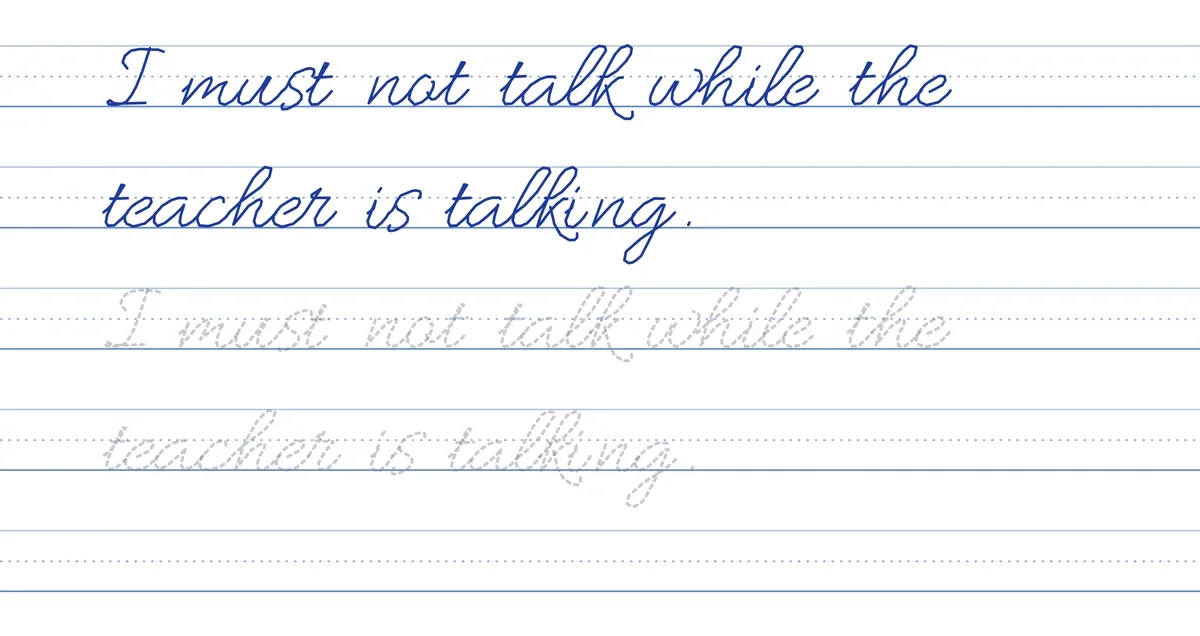
Try it now: type a line and watch it written stroke by stroke.
Open the handwriting repeaterFrequently asked questions
How many lines is normal?
Most impositions are between 50 and 200 lines, though it varies by school and teacher. Larger numbers, such as 500, are less common and usually follow repeated behaviour.
Can a school give lines as a punishment?
In England, yes, as long as the sanction is reasonable and proportionate. Your school’s behaviour policy sets out the sanctions it uses.
Do lines have to be handwritten?
Usually, yes. Only type or print them if your teacher says you can.
Can I write one word down the page at a time?
You can, but many teachers reject lines written in columns. Write each sentence in full instead.
What if my child finds handwriting physically difficult?
Speak to the class teacher or the school’s SENCo. The law expects schools to take special educational needs and disabilities into account when they set a sanction.
What does “impot” mean?
Impot is an old, informal short form of “imposition”, used mainly in British schools.