b and d Reversals: Why Children Mix Them Up and How to Help
Most children mix up b and d at some point. It often starts in Reception and fades by the end of Year 2, but it can still worry parents, especially when someone mentions dyslexia. Here’s why it happens, what’s normal for your child’s age, and the tricks that help letters stay the right way round.
Why children mix up b and d
From the time they’re babies, children learn that an object stays the same whichever way it faces. A cup pointing left is still a cup, and a dog facing the other way is still the same dog. That’s a useful skill for everyday life, but letters break the rule. Turn a b round and it becomes a d, with a different sound and a different meaning. Your child has to unlearn something their brain has always done, and that takes time.
It doesn’t help that b, d, p and q are all made of the same two parts: a straight stick and a round shape. The only difference is which side the round goes and whether the stick points up or down. If a child writes from memory before the movement feels automatic, they guess, and half the time the guess is wrong.
That’s also why your child might get it right on Monday and wrong on Tuesday. When they’re tired, rushing or thinking hard about spelling, there’s less attention left for which way a letter faces.
What’s normal at each age
Most specialists agree that reversing these two letters is common up to the age of 7 or 8. Here’s roughly what to expect:
| School year | What’s usual |
|---|---|
| Reception (age 4 to 5) | Very common in both reading and writing. Nothing to worry about at this stage. |
| Year 1 (age 5 to 6) | Still common, especially when your child is tired or writing quickly. |
| Year 2 (age 6 to 7) | Less frequent. Most children only slip now and then, and often spot it themselves. |
| Year 3 and above (age 7 to 8+) | If it still happens often, it’s worth a chat with the teacher. |
Are b and d reversals a sign of dyslexia?
On their own, no. Children with and without dyslexia reverse letters when they start learning to read and write. Dyslexia is mainly about linking sounds to letters, rather than seeing letters backwards, although children with dyslexia may keep reversing them for longer than their classmates.
It’s more useful to look at the bigger picture. The signs of dyslexia listed by the NHS include reading below the level expected for their age, slow and hesitant reading aloud, and messy written work with lots of spelling mistakes. If you notice several of these, or reversals carry on past Year 2 alongside reading problems, talk to the school’s SENCo. They can arrange a screening test and suggest extra support.
Start with how each letter is formed
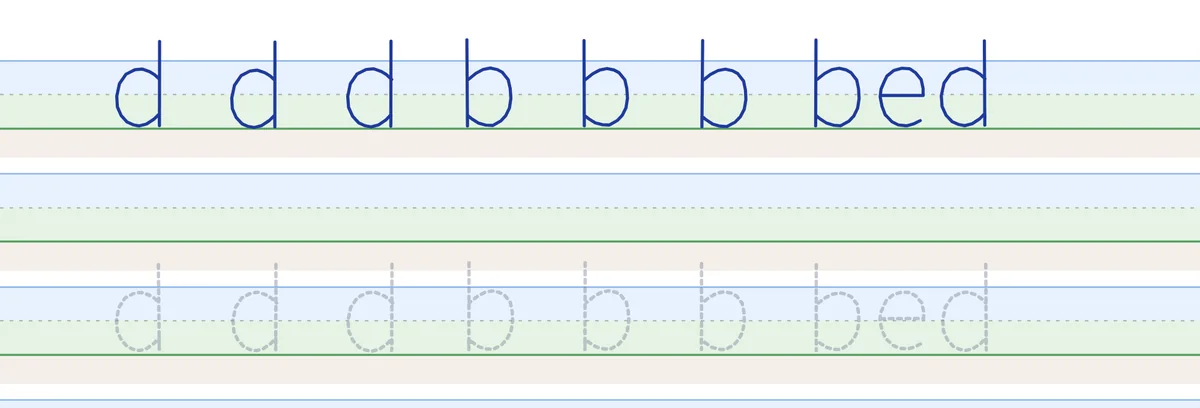
Many mix-ups happen because a child forms b and d the same way, starting with a stick every time. In most UK handwriting schemes, the two letters actually start in different places:
- d starts like c. Go round anticlockwise first, then up tall and back down the stick.
- b starts with the tall stick. Go from the top down to the line, back up halfway and round the tummy.
Because the two letters begin differently, the hand learns two different movements, and that makes them much harder to confuse. Say the strokes out loud while writing: “round like c, up and down” for d, and “down the stick, up and round” for b.
If your child’s school teaches different starting points, follow the school’s way instead. What matters most is that home and school match, so your child only has to remember one set of movements.
Watching the strokes happen makes the difference clear. Type b or d into our handwriting repeater tool, slow the Write Speed right down and press Rewrite! to see exactly where the pen starts and which way it goes.
Tricks that help the letters stay the right way round
- Use the bed trick. Write the word bed and draw a mattress across the top. The b is the headboard and the d is the footboard. You can also make it with your hands: two fists with thumbs up, knuckles facing each other. The left hand makes a b and the right hand makes a d.
- Teach one letter at a time. Work on d until it’s secure, because it links to c, which children rarely reverse. Only then add b. Practising both side by side often keeps the confusion going.
- Try the c check. If your child can start the letter with a c, it’s a d. If it starts with a stick, it’s a b.
- Make it big and physical. Write giant letters in the air with a straight arm, in sand, with a finger on your child’s back or with a wet paintbrush on the patio. Big movements help the pattern stick.
- Keep a model in sight. A small card on the table showing bed, or an alphabet strip, lets your child check instead of guessing.
- Practise in real words. Letters on their own soon get boring. Words give the practice a purpose and help with reading at the same time.
- Praise the spot, not just the fix. When your child notices their own mix-up, make a fuss of it. Spotting mistakes is how the habit finally goes.
A five minute daily routine
Short practice every day beats a long session once a week. This routine fits into a busy evening and needs nothing more than paper and a pencil.
- Warm up (1 minute). Air write a giant d three times with a straight arm, saying “round like c, up and down” as you go.
- Watch (1 minute). Write the letter slowly on a whiteboard while your child watches where you start.
- Write (2 minutes). Your child writes five of the letter on lined paper, then three words from the list below.
- Check (1 minute). Your child circles their best letter and any that face the wrong way.
Stay with d for a week, then do the same with b. In the third week, mix the two using the words that contain both letters. Keep it short and stop while your child still wants to carry on.
When the mix-ups happen in reading
Reversals often show up in reading too, such as reading dig as big. Rather than correcting straight away, ask your child whether the sentence makes sense. Then point to the letter and ask them to say its sound. Checking the meaning teaches children to catch their own mistakes, which matters more in the long run than getting every letter right first time.
Words to practise
Start with one list, then mix them once your child feels confident.
| Type | Words |
|---|---|
| With b | bat, bus, bin, web, cab, rub, bell, bird |
| With d | dog, dad, red, mud, kid, duck, door, desk |
| With both | bed, bad, dab, bud, bead, bold, board, build |
You’ll find ten more lines that mix up b, d, p and q at the end of our 100 practice sentences.
What about p and q?
p and q are mirror images too, so they cause the same kind of trouble. The same fix works: p starts with the stick going down below the line, then back up and round, while q starts like c, then goes up and down below the line. There’s a handy extra clue as well: in English words, q is nearly always followed by u, as in queen, quick and squash.
When to ask for help
Have a word with your child’s class teacher or the school’s SENCo if:
- reversals still happen often in Year 3 and beyond
- your child also finds it hard to link letters to their sounds, or reading feels much harder for them than for classmates
- they lose their place when reading, struggle to copy from the board or rub their eyes a lot
For that last group, book an eye test as well. NHS sight tests are free for children under 16, and an optician can rule out problems with vision.
Frequently asked questions
At what age should a child stop reversing b and d?
Most children stop by the age of 7 or 8. Occasional slips after that are normal, especially when your child is tired or rushing.
Is reversing letters a sign of dyslexia?
Not on its own. Most children reverse letters while they’re learning. Look for other signs too, such as slow reading or a lot of spelling mistakes, and talk to the school’s SENCo if you’re worried.
How can I help my child remember b and d?
Try the bed trick. Write the word bed, where b is the headboard and d is the footboard, or make the shape with two thumbs-up fists.
Why does my child write some numbers backwards?
Numbers such as 3, 5 and 9 have the same problem as b and d: their shape still makes sense when flipped. Teach where each number starts, and the reversals usually fade by age 7 or 8.
Should I correct every reversal?
No. Pick one or two moments in a session, keep it light and praise your child when they spot a mix-up themselves. Constant correcting can put them off writing.