Letter Formation: How to Form Every Letter from a to z
Ask any Reception teacher what matters most in early writing, and many will say the same thing: where each letter starts. Good letter formation means your child begins every letter in the right place and moves the pencil in the right direction. Get that right at five, and neat, quick, joined writing follows much more smoothly later on.
What good letter formation looks like
A letter can look right on the page and still be formed the wrong way. An o drawn clockwise from the bottom looks fine, but it slows your child down and makes joining hard later. Teachers check three things:
- Start point. Most lowercase letters start at the top. Round letters start just below the top, at about two o’clock.
- Direction. Round letters go anticlockwise, like the start of a c. Straight lines go down, not up.
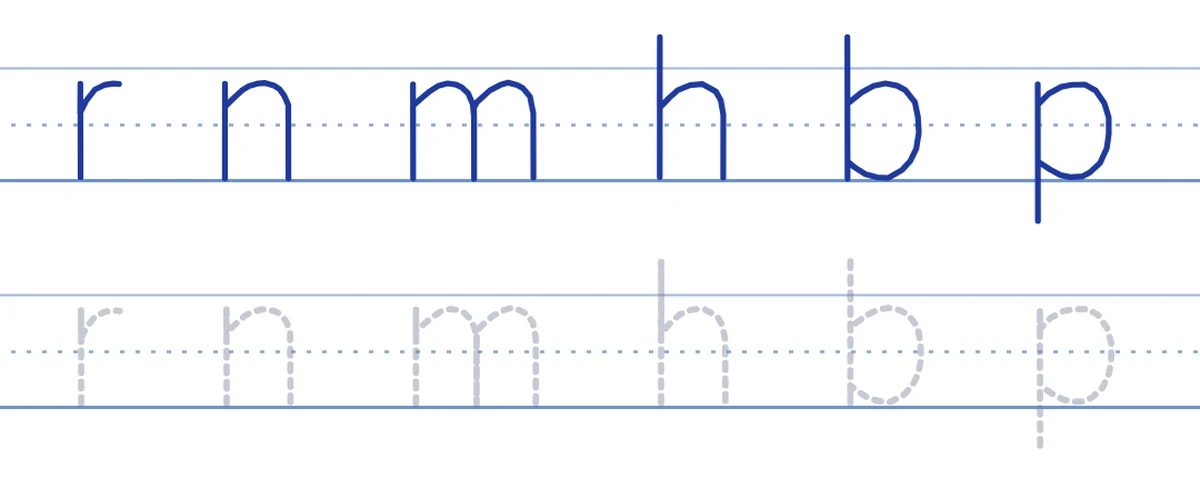
- Size. Tall letters reach the sky line, small letters sit between the grass and the middle line, and tails drop below the line.
Year 1 is when this becomes formal. The national curriculum’s Year 1 programme of study asks children to start and finish lowercase letters in the right place, form capitals and the digits 0 to 9, and know which letters belong to which handwriting family.
Four families that cover every letter
Most UK schools group the alphabet into four families. Letters in each family start with the same movement, so once your child knows one, the rest come quicker. Your child’s school might use different names, such as Letter-join’s or Nelson’s, but the groups are usually close to these.
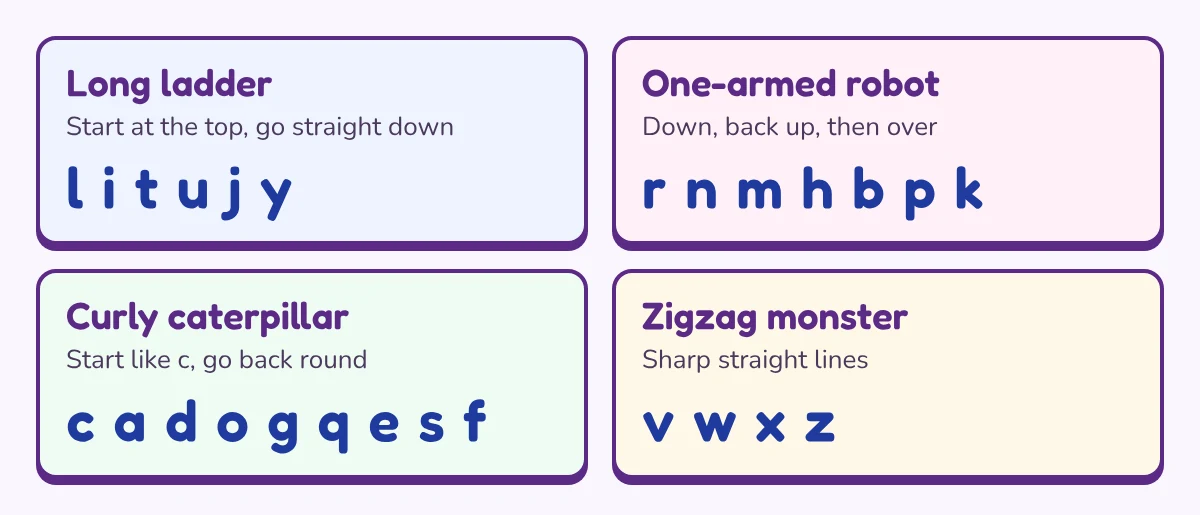
| Family | Letters | Shared movement |
|---|---|---|
| Long ladder | l, i, t, u, j, y | Start at the top and go straight down |
| One-armed robot | r, n, m, h, b, p, k | Go down, back up the same line, then over |
| Curly caterpillar | c, a, d, o, g, q, e, s, f | Start like a c, going back and round |
| Zigzag monster | v, w, x, z | Sharp, straight lines with no curves |
How to form each lowercase letter
Say the movement out loud while your child writes. Short phrases such as “down, up and over” give the hand a pattern to follow, and they stick far better than “no, not like that”.
Long ladder letters
- l: start at the sky line, go straight down to the grass.
- i: start at the middle line, go down, then add the dot.
- t: start a little below the sky line, go down, curve at the bottom, then cross.
- u: down, round the bottom, up, then back down the same line.
- j: start at the middle line, go down below the grass, hook to the left, then add the dot.
- y: down, round and up like u, then down below the line and hook to the left.
One-armed robot letters
- r: down, back up the same line, then a small arm over.
- n: down, back up, over the hump and down.
- m: like n, then another hump.
- h: start at the sky line, go down, back up halfway, over and down.
- b: start at the sky line, go down, back up halfway and round the tummy.
- p: start at the middle line, go down below the grass, back up and round.
- k: tall line down, back up halfway, in to the middle and kick out.
Curly caterpillar letters
- c: start just below the middle line, go over the top and round anticlockwise.
- a: round like c, up to the middle line, then straight down.
- d: round like c, up tall to the sky line, then back down.
- o: round like c and close it at the top.
- g: round like c, up, then down below the line and hook to the left.
- q: round like c, up, then straight down below the line. Some schemes add a small flick to the right.
- e: across the middle first, then up and round like c.
- s: start like a small c, then curve back the other way.
- f: start below the sky line, curve over the top, go down, then cross at the middle line.
Teaching d as “round like c, then up” does more than tidy one letter. It’s also the best fix for children who swap b and d, because the two letters now begin with completely different movements.
Zigzag monster letters
- v: slant down to the grass, then slant back up.
- w: down, up, down, up, like two v shapes joined.
- x: slant down from left to right, lift the pencil, then slant down from right to left.
- z: across the middle line, slant down to the left, then across the grass.
Capital letters and numbers
Every capital letter starts at the top, which makes them a little more forgiving than lowercase. Most begin with a straight line down, as in B, D, E, F, H, K, L, M, N, P and R. Round capitals such as C, G, O, Q and S start at two o’clock and go anticlockwise, just like their small versions.
Children often learn capitals first, from writing their name. That’s fine, but keep capitals for names and the start of sentences. A child who writes “BEd” or “haPPy” usually knows the capital better than the small letter, so give that lowercase letter some extra practice.
Numbers follow the same rule: start at the top. A few have their own quirks:
- 0 starts at the top and goes anticlockwise, like o.
- 5 goes down, round the tummy, then the hat goes on last.
- 8 starts like s, then comes back up to close.
- 3, 5, 7 and 9 are the ones children most often write backwards. Keep a number line in sight while they practise.
Common mistakes and how to fix them
| What you see | What to try |
|---|---|
| Starting at the bottom | Put a small green dot where the letter starts. Your child places the pencil on the dot every time. |
| Round letters going clockwise | Practise a row of c shapes first. Then turn each one into a, d, g or o. |
| Letters built from bits | An a made as a circle plus a separate stick won’t join later. Ask your child to keep the pencil on the paper for the whole letter. |
| Every letter the same height | Use paper with a middle line, or draw sky and grass lines. Ask which letters are tall, which are small and which have tails. |
| Shaky, heavy lines | Check the grip. White fingertips or a sore hand mean your child is pressing too hard. |
That last one catches a lot of families out. Wobbly letters often have nothing to do with knowing the shape. Help your child find a relaxed pencil hold first, and the lines usually smooth out by themselves.
What to expect at each age
Children don’t all move at the same speed, so treat this as a rough picture rather than a checklist.
| Age | What’s usual |
|---|---|
| Nursery (3 to 4) | Big movements and patterns: circles, zigzags, lines down. Some children write a few letters from their name. |
| Reception (4 to 5) | Most lowercase letters are recognisable and many start in the right place. By the end of the year, most children form most letters correctly. |
| Year 1 (5 to 6) | Starts and finishes each letter in the right place, forms capitals and numbers, and practises letters in their families. |
| Year 2 (6 to 7) | Letters are the right size compared with each other, and children start the strokes needed to join. |
Once each letter starts and finishes in the right place, your child is ready to join their letters. Many UK schools teach small lead-in and exit strokes from Reception or Year 1 for exactly this reason.
A 10 minute practice routine
Ten minutes a day works better than an hour on Saturday. Pick one family each week. Ladder letters are the gentlest place to start, then caterpillar, robot and zigzag.
- Warm up (1 minute). Draw the family’s shape big in the air with a straight arm: a long line down, a c, a robot arm or a zigzag.
- Watch (2 minutes). Type the letters into our free handwriting practice tool and slow the Write Speed down. Your child watches where the pen starts and which way it moves.
- Trace (3 minutes). Turn on Trace Mode and let your child follow the faded letters with a finger or stylus, or print a sheet and trace with a pencil.
- Write (3 minutes). Three of each letter on their own, then two or three short words from the same family, such as till, cod or him.
- Check (1 minute). Your child circles their best letter. Praise the start point, not just the look.
Once single letters feel steady, move on to words and then short practice sentences. Writing real words keeps practice from getting dull, and it shows your child why the letters matter.
Follow your child’s school
Schemes differ in small ways. Some teach letters with lead-in lines from day one, some use a straight q and others add a flick, and the family names change from school to school. If your child’s teacher shows a different start point from the one here, go with the school. One clear way of doing it, used at home and in class, beats the “right” way taught in two different styles.
Frequently asked questions
What are the four letter families?
Long ladder letters (l, i, t, u, j, y), one-armed robot letters (r, n, m, h, b, p, k), curly caterpillar letters (c, a, d, o, g, q, e, s, f) and zigzag monster letters (v, w, x, z). Each family starts with the same movement.
At what age should a child write letters correctly?
Most children form most lowercase letters correctly by the end of Reception, around age 5. By the end of Year 1, they should start and finish every letter in the right place.
Should my child learn capital or lowercase letters first?
Lowercase first. Most of what children read and write is lowercase, so that’s where practice pays off. Capitals are fine for their name and the start of a sentence.
Why does my child start letters from the bottom?
Often they learned the shape by copying it, not by watching it being written. Watch the letter written slowly, then mark the start with a dot so your child knows where the pencil goes first.
Is it too late to fix how my child forms letters?
No. Older children can change a habit, it just takes a bit longer. Work on a few letters at a time, starting with the ones that cause the most trouble, and keep sessions short.
Should children learn print or cursive first?
Most UK schools start with print letters, often with small lead-in or exit strokes, and move to joined writing in Year 2. Follow whatever your child’s school uses.