Pencil Grip for Children: What’s Normal and How to Help
Lots of parents worry the first time they see their child clutching a pencil in a fist, or wrapping a thumb right over their fingers. Most of the time, it’s a normal stage. Here’s how grip develops, which grips work well, and what to do at home when one doesn’t.
How grip changes as children grow
Children don’t start with a neat grip. They work through a few stages, and each one builds the strength for the next. These ages are rough, and plenty of children move a little faster or slower.
| Age | What you’ll usually see |
|---|---|
| 1 to 2 years | The whole fist wraps round the crayon, and the arm moves from the shoulder. |
| 2 to 3 years | All the fingers hold the shaft, with the palm facing down. The movement comes from the elbow. |
| 3 to 4 years | Three or four fingertips hold the pencil, but the whole hand still moves as one. |
| 4 to 6 years | The thumb and first two fingers hold the pencil, and the fingers start to move on their own. |
So if your Reception child still looks a bit clumsy with a pencil, they’re most likely partway through. A mature grip often doesn’t settle until 5 or 6.
What a comfortable grip looks like
The grip most teachers aim for is the tripod. Your child pinches the pencil between the thumb and first finger, and it rests on the side of the middle finger. Check for these things:
- Fingers sit about 2 cm from the tip, not right down on the point.
- The gap between the thumb and first finger stays open and round, not squashed flat.
- The ring finger and little finger curl gently into the palm.
- The fingers make the small movements, while the wrist rests on the table.
- The hand looks relaxed. If the fingertips go white, the grip is too tight.
Other grips that work just as well
Plenty of children, and adults, hold a pencil a little differently and still write neatly. Some wrap the thumb over the first finger. Others use four fingers instead of three.
That’s backed by research. A 2012 study of 120 children aged 9 and 10 compared the tripod with three other mature grips and found no real difference in how fast or how neatly they wrote. If your child writes comfortably, clearly and at a sensible speed, you don’t need to change how they hold the pencil.
Signs a pencil grip needs help
Look at how writing feels for your child, not just how the grip looks. These are worth acting on:
- Their hand or wrist aches after a few lines.
- They press so hard that the paper dents or tears.
- The thumb wraps tightly over the fingers, so the round gap disappears.
- The hand hooks round above the line they’re writing on.
- They write very slowly, tire quickly or try to avoid writing.
Ways to help at home
Small, regular nudges work far better than correcting every line. Pick one or two of these and stick with them for a few weeks.
- Give them short pencils. Broken crayons and short golf pencils leave no room for the whole fist, so children naturally use their fingertips.
- Try the pinch and flip. Lay the pencil on the table with the point facing your child. They pinch it near the point with the thumb and first finger, then flip it back over so it rests on the middle finger.
- Tuck something into the palm. A small ball of cotton wool held by the ring finger and little finger keeps those fingers curled and out of the way.
- Mark where the fingers go. A small sticker or a line of colour about 2 cm from the tip shows exactly where to hold.
- Check the grip before writing, not during. Set it up once at the start, then let them write. Constant reminders mid-sentence put children off.
- Build finger strength through play. Playdough, pegs, tweezers and beads, Lego, tearing paper and threading all strengthen the small muscles a good grip needs.
- Write on a slope. An easel, a whiteboard on the wall or a sloped board helps a child whose wrist bends right back or hooks over the line. A lever arch file turned on its side makes a quick one.
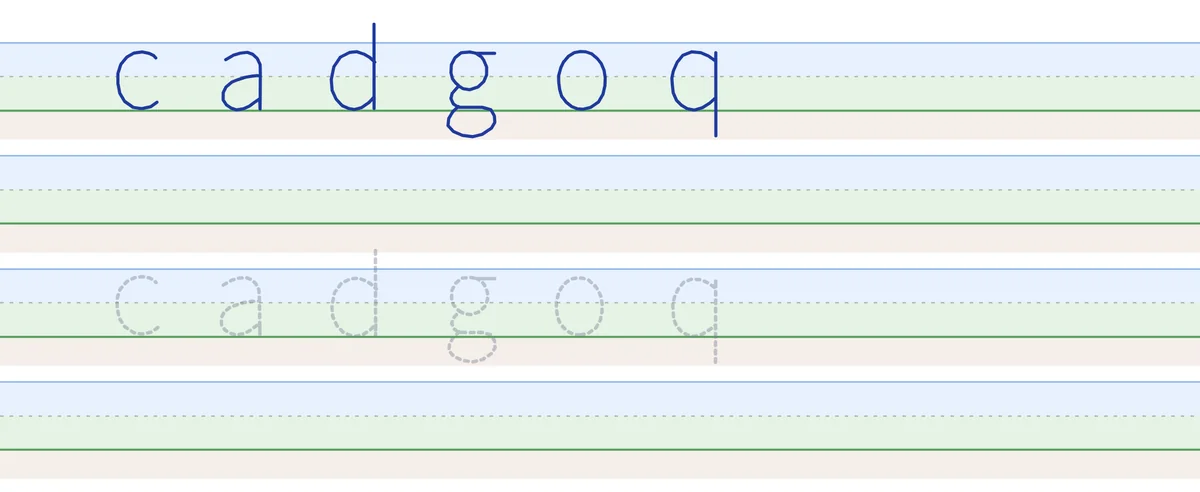
Grip is only half the job. Children also need to know where each letter starts and which way it goes. With a repeat writer handwriting tool, your child can watch a letter written slowly, stroke by stroke, then trace it while you keep an eye on their grip.
Do rubber grips help?
Grips that slide onto the pencil can help for a while, especially for a child who squeezes hard or keeps sliding down to the point. They hold the fingers in place rather than teach the movement, though. Use one alongside the strength games above, then take it away over a few weeks so your child doesn’t come to rely on it.
Left-handed children
Left-handers can use the same grips, but a few changes make writing much more comfortable:
- Hold the pencil a little further from the tip, about 3 cm, so they can see what they’ve written.
- Tilt the paper to the right, so the hand stays below the line instead of hooking over it.
- Sit them on the left of a right-handed child, so their elbows don’t bump.
- Use pens that dry quickly to cut down on smudges.
Is it ever too late to change a grip?
By about 8 or 9, a grip is very hard to change. If it doesn’t hurt and the writing is clear and quick enough, leave it alone. If it causes pain or slows your child down, smaller changes can still help, such as a sloped board, a thicker pencil or a triangular one.
When to ask for help
Speak to your child’s teacher or the school’s SENCo if your child still holds a pencil in a fist when most of the class has moved on, if writing hurts, or if they also find buttons, cutlery or scissors hard. These can be signs of a coordination difficulty such as dyspraxia. The school can ask for advice from your local NHS children’s occupational therapy service.
Frequently asked questions
At what age should a child hold a pencil properly?
Most children settle into a mature grip between 4 and 6. Some take a little longer, and that’s usually fine if writing feels comfortable.
Is it bad to hold a pencil with four fingers?
No. Research shows that a four-finger grip works just as well as the tripod for speed and neatness, as long as your child writes comfortably.
Why does my child press so hard when writing?
Hard pressing often comes from a tight grip or weak hand muscles. Strength games, a softer pencil such as a 2B and short, relaxed practice sessions usually help.
Should I make my left-handed child use their right hand?
No. Let your child use the hand that feels natural. Most children settle on one hand by the time they start school.