Left-Handed Handwriting: Tips to Help Your Child Write
About one child in ten writes with their left hand, so most classes have two or three. Many of them get on fine, but others end up with smudged pages, a sore wrist and writing that looks rushed even when it isn’t. Nearly all of it comes from a few small things in the set-up: where the paper goes, where your child sits and how they hold the pencil. Fix those early and the writing usually follows.
Why left-handed handwriting feels harder
We write English from left to right. A right-hander pulls the pencil away from the body and their hand moves out of the way of the words. A left-hander has to push the pencil across the page, and their hand travels over everything they’ve just written.
That causes three problems you’ll probably recognise:
- Your child can’t see the words. The hand covers the line, so they lose their place or leave out letters.
- The page smudges. The side of the hand drags through wet ink or soft pencil.
- The wrist hooks. To see past their hand, many left-handers curl the wrist over the top of the line. It works, but it tires the hand and often slows writing down.
None of this means your child is bad at writing. Their equipment and seating were set up for the other hand.
Is your child really left-handed?
Young children often switch hands, and that’s normal. Hand preference usually becomes clear somewhere between ages 4 and 6. Until then, put crayons, spoons and toys in the middle, in front of your child, and let them choose which hand to use.
Never push a child to write with their right hand. Switching rarely works, it slows learning and it can knock their confidence. If your child picks the left, back that choice and set them up for it.
Get the paper position right
If you only change one thing, make it this. Paper position decides where the hand sits, and the hand decides almost everything else.
- Place the paper to the left of your child’s middle, not straight in front.
- Turn the top of the page to the right, about 20 to 30 degrees. It should look like the bottom left corner is pointing at their tummy.
- Your child’s hand should rest below the writing line, so they can see each word as they write it.
- Their right hand holds the paper still, near the top.
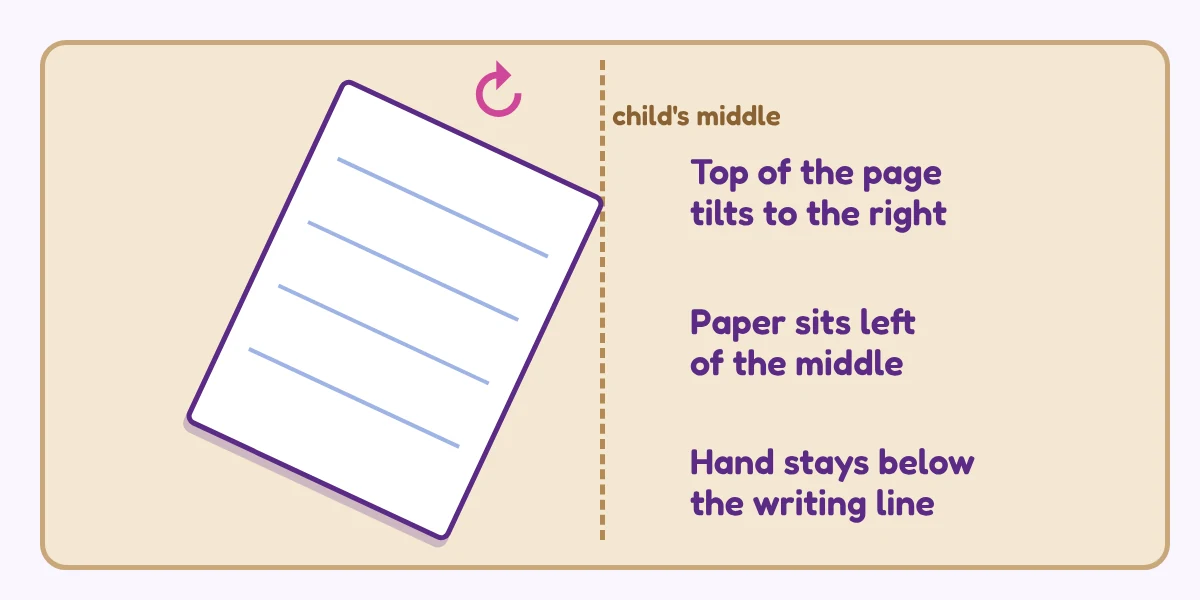
A small strip of masking tape on the table at the right angle helps a lot at home. Your child lines the page up with the tape every time, and the habit forms without constant reminders.
Where to sit and where the light falls
Seating sounds like a small detail, but it causes a surprising number of problems in class.
- Sit on the left. At a shared table, a left-hander should sit on the left of a right-hander. Otherwise their elbows clash all lesson.
- Leave room on the left. The writing arm needs space to move, so the left elbow shouldn’t hit a wall or the table edge.
- Light from the right. If the lamp or window is on the left, the hand throws a shadow over the line.
- Sit a little higher. A cushion or a slightly taller chair helps your child see over their hand.
These are worth mentioning to the class teacher too. Most teachers will happily move a seat once they know.
Grip and pencils that help
Left-handers use the same tripod grip as everyone else, with two small changes:
- Hold further up. Fingers should sit about 2.5 to 3 cm from the tip, a little further back than a right-hander. That gives your child a clear view of the point.
- Keep the pencil pointing back. The top of the pencil should point towards the left shoulder, not out to the side.
A small sticker on the pencil at the right height reminds your child where to hold without you saying a word.
As for equipment, a few things really do make a difference:
- Pencils: a soft HB or a triangular pencil glides better than a hard one. Some brands, such as the Stabilo EASYgraph, come in left-handed versions with grip shapes made for the left hand.
- Pens: once your child moves to pen, choose ink that dries quickly. Gel pens and many fountain pens smudge badly for a left-hander.
- Scissors: left-handed scissors matter more than any pencil. Normal scissors hide the cutting line and pinch a left hand.
- A slope: a writing slope, or a lever arch file turned on its side, brings the page up and helps keep the wrist straight.
Stopping the hook and the smudge
A hooked wrist is a sign your child can’t see what they’re writing. Correct the paper position first and the hook often fades by itself, because the hand no longer needs to climb over the line.
For smudging, try these:
- Use a slightly harder pencil, such as HB rather than 2B, which leaves less loose graphite on the page.
- Rest a piece of scrap paper under the side of the hand while writing.
- In pen, write with a quick-drying ink and give each page a moment before turning over.
If your child is 8 or older, writes quickly and clearly with a hook, and has no pain, leave it alone. Changing a settled habit at that age can do more harm than good. Step in only when the hook causes pain, very slow writing or messy work that your child is unhappy with.
Letters that feel awkward
Left-handers start and finish letters in the same places as everyone else, and the same letter families still apply. A few strokes do feel different, though.
- Crossing t and f. Many left-handers cross from right to left. That’s fine for single letters. Once your child starts joining, the cross needs to lead into the next letter, so practise left to right then.
- Pushing round letters. c, a, d and o still go anticlockwise. Left-handers sometimes reverse them because pulling feels more natural. Watch the start of each one.
- Mirror writing. Some young left-handers write words back to front, from right to left. It looks alarming, but it usually fades by about age 7, in the same way as children who write single letters back to front.
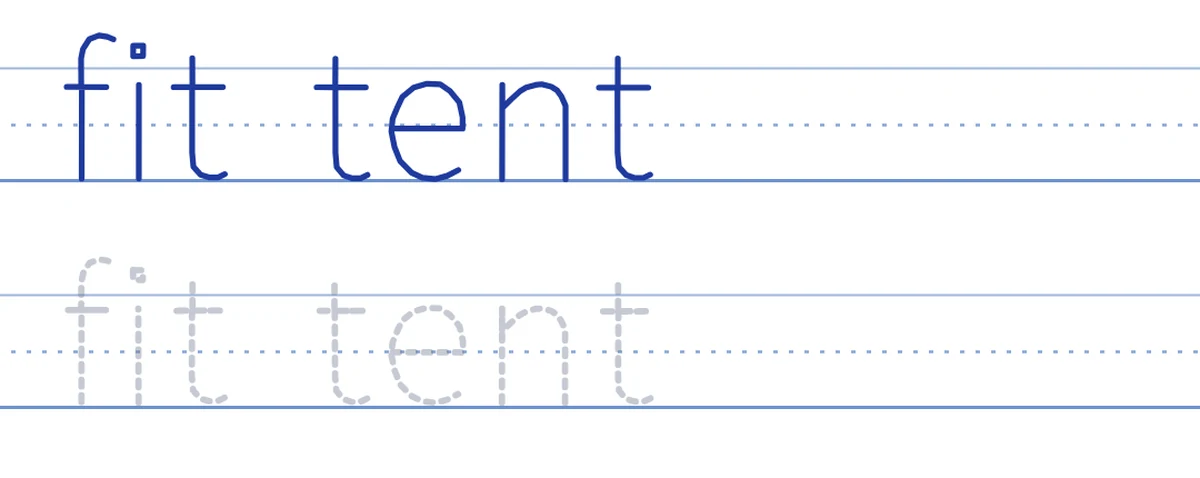
Left-handers learn joined writing just as well as anyone. Many find a gentle forward slant hard, so an upright style, or even a slight backward lean, is completely fine as long as it stays the same throughout.
A week of short practice sessions
Ten minutes a day, at the same table with the same set-up, builds the habit fastest.
- Days 1 and 2: set up the tape, the paper angle and the pencil sticker. Do patterns only: lines down, loops and waves across the page.
- Days 3 and 4: watch single letters written slowly in our handwriting tracing tool, then trace them with a finger or stylus. Your child can concentrate on the movement without worrying about the hand position on paper.
- Days 5 and 6: write short words with t and f, such as fit, tent, left and after, checking the hand stays below the line.
- Day 7: copy two or three of our sentences for each year group. Ask your child whether they could see every word as they wrote it.
What to ask your child’s school
Teachers deal with a lot of children, and a left-hander’s needs can get missed in a busy classroom. A short, friendly note covering these points helps:
- Can my child sit on the left of a right-hander, with room for their elbow?
- Do they have left-handed scissors in class?
- Can they tilt their book to the right when writing?
- Is their pen licence judged on clear, steady writing rather than a forward slant?
Many councils publish advice for schools on left-handed writing. Surrey County Council’s tips for left-handed writers cover seating, paper and pens in plain terms, and they’re handy to share with a teacher.
When to get extra help
Talk to the class teacher or the school’s SENCo if your child:
- still complains of a sore hand or wrist after the set-up changes
- writes much more slowly than classmates and can’t keep up in lessons
- avoids writing or gets upset by it
They may suggest a referral to an occupational therapist, who can look at grip, posture and hand strength in detail.
Frequently asked questions
Should I make my child write with their right hand?
No. Forcing a switch rarely works and can slow down learning to write. Support the hand your child chooses and set up their paper, seat and pencil for it.
At what age can you tell if a child is left-handed?
Most children show a clear hand preference between ages 4 and 6. Before that, swapping hands is normal, so let your child choose freely.
Is it bad for left-handers to hook their wrist?
Not always. If an older child writes clearly, quickly and without pain, the hook can stay. In younger children, changing the paper position often stops the hook before it sets in.
Do left-handed children need special pencils?
Not usually. A soft, smooth pencil held a little further from the tip works well. Left-handed scissors make a bigger difference, and some children like left-handed grip pencils.
Why do left-handers smudge their writing?
Often the paper is straight in front of them, so their hand drags across the words. Move the paper to the left, tilt the top to the right and see whether neatness improves within a couple of weeks.
Can left-handed children learn joined handwriting?
Yes. Left-handers join letters just as well as right-handers. An upright or slightly backward slant is fine, as long as it stays the same.