100 Handwriting Practice Sentences, Sorted by Year Group
Copying a good sentence is one of the quickest ways to improve handwriting. A whole sentence makes you form letters, join them, space the words and keep everything on the line at the same time. Below you’ll find 100 sentences sorted by school year, plus lines for adults, pangrams and sentences for letters that often get mixed up.
How to use these handwriting practice sentences
Pick three sentences a day rather than thirty. Ten careful minutes do more good than an hour of tired writing.
- Read the sentence out loud, so you know it by heart.
- Write it slowly once, and keep the small letters the same height.
- Write it again at your normal speed.
- Compare the two and circle your best word. Next time, try to make every word look like that one.
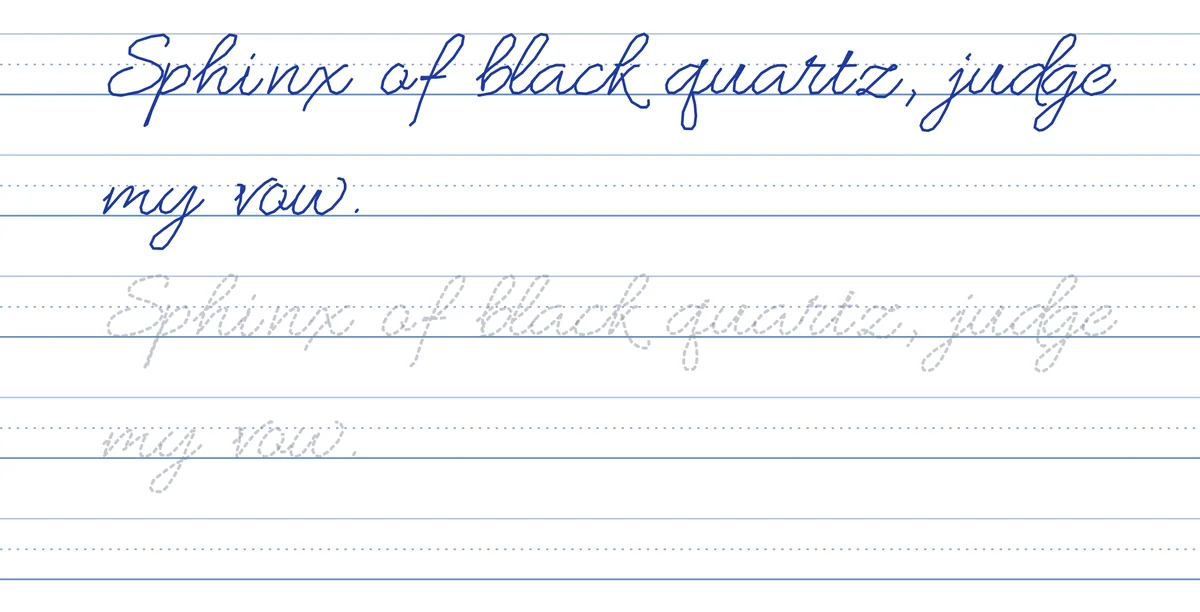
If you’d like a model to trace first, paste any sentence into our online handwriting repeater. It writes the sentence stroke by stroke, then turns it into a sheet with a line to read, a line to trace and a line to copy.
Sentences for Reception and Year 1
These use short, everyday words, so children can focus on forming each letter correctly. Many include common exception words from the Year 1 list in the national curriculum, such as the, my, to and school. Write them in print, with a finger space between each word.
- I can see a big red bus.
- The cat sat on a mat.
- Mum has a hot cup of tea.
- Dad got wet in the rain.
- I like to jump in the mud.
- The dog ran to the park.
- We had fish and chips.
- A duck is in the pond.
- My hat is on the bed.
- Sam can hop on one leg.
- The sun is out today.
- I fed the hen some corn.
- Look at the big ship.
- We go to school on the bus.
- The frog sat on a log.
Sentences for Year 2: first joins
Year 2 is when most children start joining letters. These sentences are full of the first joins they learn, such as an, in, ch and th. If your child’s school hasn’t started joining yet, they can write them in print.
- Nan can win a tin of mints.
- I am in the sun.
- Mum puts the hat in the bin.
- The chick hid in the hutch.
- Tim ran up the hill.
- The thin cat sat at the gate.
- Dan and Kim had lunch at three.
- It is time to clean the sink.
- My aunt sang a funny tune.
- The children sat in a ring.
- Think of an animal that can swim.
- Lily lit a candle at teatime.
- The tulips came up in spring.
- Hunt for shells in the sand.
- I will thank my teacher.
Sentences for Years 3 and 4: harder joins, capitals and commas
These bring in the trickier joins that start at the top of a letter, from o, r, v and w. They also practise capital letters for names and places, and commas in lists.
- We walked to the woods on Sunday.
- Our boat floated over the water.
- Rory wore his warm woolly coat.
- Owls hoot in the old oak tree.
- Olivia found four round stones.
- Where would you go if you could fly?
- Grandad grows roses, beans and carrots.
- We visited Cardiff, Bristol and Bath.
- The robot rolled over the rug.
- Why do worms come out when it rains?
- My brother loves football, comics and pizza.
- On Bonfire Night, we wrapped up warm.
- Oscar wrote a note to Victoria.
- The view from the tower was wonderful.
- Who borrowed my yellow umbrella?
Sentences for Years 5 and 6: speed and punctuation
Older pupils need to write neatly and quickly. These longer sentences practise speech marks, apostrophes and commas. A few include words from the Year 5 and 6 spelling list, such as necessary, rhythm and neighbour.
- “Hurry up,” called Mum, “or we’ll miss the train!”
- Although it was raining, the match carried on.
- The scientists recorded the temperature every hour.
- Our class’s bake sale raised £85 for charity.
- If I had a time machine, I would visit the Romans.
- Remember to bring a coat, a packed lunch and a water bottle.
- The old castle on the hill has stood for nearly a thousand years.
- “Have you finished your homework?” asked Mr Patel.
- It’s necessary to practise every day if you want to improve.
- The orchestra played with a steady rhythm.
- My neighbour’s cat climbed onto the shed roof.
- Shooting stars streaked across the dark sky.
- We couldn’t believe how quickly the year had gone.
- The volcano erupted, sending ash high into the air.
- Write neatly, keep your letters the same size and leave a space between words.
Sentences for secondary school and exam practice
In exams, examiners can only mark what they can read. These sentences use the kind of words that come up in GCSE subjects, so pupils can practise writing them neatly against the clock.
- In Act 1, Macbeth meets three witches on a heath.
- Photosynthesis turns light energy into chemical energy.
- The Battle of Hastings took place in 1066.
- A quadratic equation can have two solutions.
- Shakespeare uses imagery to show how guilt affects Lady Macbeth.
- Compare how both poets present the theme of conflict.
- The results suggest that temperature affects the rate of reaction.
- Rivers wear away their banks as they flow towards the sea.
- Explain why the Industrial Revolution began in Britain.
- Always check your answer against the question before you move on.
Sentences for adults
Most adults only write by hand for cards, notes and forms, so practise the things you actually write. Try these in your own style, then work on the letters that look least tidy.
- Thank you so much for the lovely flowers.
- Happy birthday! Wishing you a wonderful year ahead.
- Please leave the parcel with my neighbour at number 12.
- Milk, bread, eggs, apples and teabags.
- Back in ten minutes. Please wait here.
- I’m writing to confirm my appointment on Tuesday at 3pm.
- Dear Sarah, it was lovely to catch up last week.
- Remember to water the plants while I’m away.
- With love and best wishes from all of us.
- Please sign below and return this form by Friday.
Pangrams: sentences that use every letter
A pangram uses all 26 letters of the alphabet at least once, so you can check every letter in one go. Write one at the start of each session to warm up.
- The quick brown fox jumps over the lazy dog.
- Sphinx of black quartz, judge my vow.
- How vexingly quick daft zebras jump!
- The five boxing wizards jump quickly.
- Jackdaws love my big sphinx of quartz.
- Bright vixens jump; dozy fowl quack.
- Quick zephyrs blow, vexing daft Jim.
- A wizard’s job is to vex chumps quickly in fog.
- The jay, pig, fox, zebra and my wolves quack!
- Amazingly few discotheques provide jukeboxes.
Sentences for letters that get mixed up
Some letters look alike, so children often write them the wrong way round. These sentences repeat the ones that cause the most trouble: b and d, p and q, n, h and u, s and z, and the numbers 6 and 9. Say each tricky letter as you write it, and check which way it faces.
- Bob’s dog dug a big hole by the bed.
- A bold bird bobbed by the back door.
- Dad bought bread and buns from the baker.
- Polly put the pears in a paper bag.
- The queen quickly packed a picnic.
- Hannah had nine hens and a hamster.
- Uncle Nathan never uses a blue pen.
- Seven silver swans swam south.
- Zara zipped up her fuzzy jacket.
- Number 6 and number 9 look alike, so write them with care.
Frequently asked questions
What makes a good practice sentence?
It should be short enough to copy in one go and mix tall letters, small letters and letters with tails. It also helps if it means something to the writer, such as a name, a hobby or this week’s spelling words.
What sentence uses every letter of the alphabet?
The best known is The quick brown fox jumps over the lazy dog. A sentence like this is called a pangram, and you’ll find nine more in the list above.
How many sentences should a child practise each day?
Three to five is plenty. Ten minutes of careful writing every day helps more than one long session a week.
Should children practise in print or joined writing?
Follow your child’s school. Most children write in print until Year 2, then start joining some letters. If you’re not sure which style the school uses, ask the teacher.
How can I make my handwriting neater as an adult?
Slow down, hold the pen lightly and keep small letters the same height. Copy one or two sentences a day and compare each attempt with the one before.