How to Improve Your Handwriting: 12 Tips That Work
Slow down, hold the pen lightly and keep your small letters the same height. Those three changes tidy up most messy writing within days. If you want to improve your handwriting for good, ten minutes of practice a day for three or four weeks makes the change stick, whether you’re 12 or 52.
Why handwriting gets messy
Messy writing almost always comes from one of a handful of causes. Spotting yours saves a lot of wasted practice.
- Rushing. Speed is the biggest one. Letters lose their shape when you write faster than your hand can control.
- Gripping too hard. A tight grip makes lines shaky and tires the hand within a page or two.
- Odd letter shapes. If some letters start at the bottom or go the wrong way round, writing them quickly turns them into scribbles.
- No practice. Many adults hardly write by hand any more. Like any skill, it slips when you stop using it.
- Tired hands. Writing gets worse towards the end of a long page because the small muscles in the hand tire. Short breaks help more than pushing on.
- Poor posture. Slouching or writing on your knee makes it hard for the arm to move smoothly along the line.
Write a sentence at your normal speed now and keep it. You’ll want it later to compare.
Quick ways to improve your handwriting today
These changes take seconds, and most people see a difference on the same page.
1. Slow down by a third
You don’t need to crawl. Write a little slower than feels natural and watch the letter shapes come back. Speed returns once the shapes are steady.
2. Loosen your grip
Hold the pen about 2 to 3 cm from the tip, resting on your middle finger. If your knuckles turn white or the pen leaves a dent in your finger, loosen your grip. The same advice works for adults as well as children.
3. Sit up and rest your arm
Keep your feet flat, your back against the chair and your forearm resting on the desk. Your arm should slide along the line, not just your fingers.
4. Tilt the paper
Right-handers tilt the top of the page slightly to the left. Left-handed writers tilt it to the right and place it a little to the left of their body.
5. Move your arm, not just your fingers
Writing tends to shrink and slope downhill as your hand stretches across the page. Move your whole hand along every few words instead.
What makes handwriting look neat
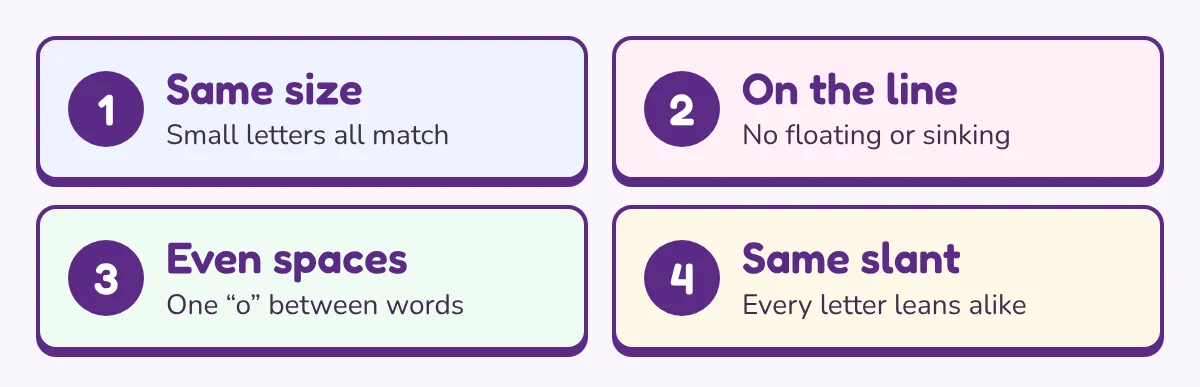
Neat writing isn’t about pretty letters. Readers judge it on four plain things, and you can check all four in a few seconds.
6. Keep small letters the same size
Letters such as a, c, e, m, n, o and s should all reach the same height. This one change makes the biggest visual difference. Tall letters such as b, d, h and l should be about twice as tall.
7. Sit every letter on the line
Letters that float above the line or dip below it look untidy, even when they’re well made. Only tails, such as on g, p and y, should drop below.
8. Space words evenly
Leave a gap about the width of a small o between words. Too little and words run together. Too much and the line looks broken up.
9. Keep the same slant
Upright, forward or slightly backward all look fine. What looks messy is a mix. Pick the lean your hand prefers and keep it on every letter.
Handwriting exercises that work
Short, focused practice beats filling pages. Each of these takes two or three minutes.
10. Warm up with patterns
Before writing, draw a row of loops, a row of zigzags and a row of waves across the line. They loosen the hand and train the same movements that letters use.
11. Fix your letters in groups
Letters that start the same way are easier to fix together. The round group, c, a, d, g, o and q, all begin like a c. If your writing looks scruffy at speed, check your letter shapes first, especially where each one starts.
12. Copy one sentence, three times
Choose a sentence that uses lots of different letters. Write it once slowly, once at normal speed and once a little faster. Compare all three and pick one thing to fix. If you need ideas, our sentences to copy, sorted by level, work for older writers too.
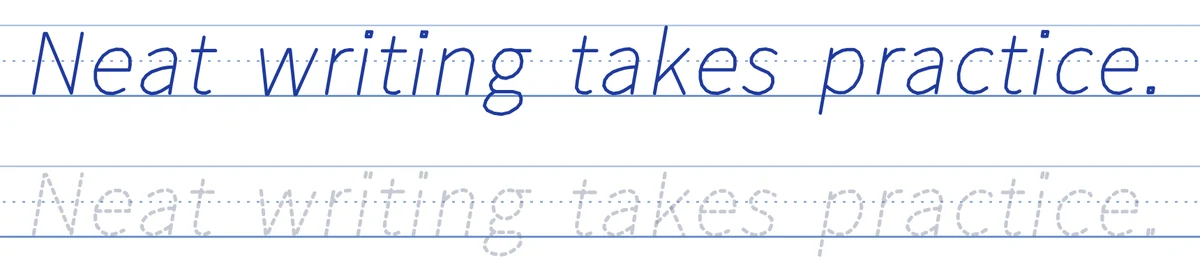
Our practice sheet maker does the setting up for you. Type your own sentence, choose a style close to the one you want, then watch it written stroke by stroke. You can trace it on screen in Trace Mode or print a sheet with a model line, a faded line and a blank line to copy.
Copying the same sentence over and over can feel like school lines, so keep sessions short and change the sentence every day or two.
Common problems and how to fix them
Look at the sentence you wrote at the start. Find your problem in the left column, then try the fix for a week before moving on to the next one.
| What you see | Likely cause | Try this |
|---|---|---|
| Lines drift uphill or downhill | Paper not tilted, or the hand stays still | Tilt the page and move your hand along every few words |
| Letters get smaller across the page | Fingers stretching instead of the arm moving | Rest your forearm and slide it along the desk |
| a looks like u, o looks like v | Round letters left open at the top | Close every round letter before moving on |
| Words crash into each other | Rushing, with no gaps | Pause for a split second after each word |
| Shaky, heavy lines | Gripping and pressing too hard | Hold the pen lightly and write on a pad, not a single sheet |
| Hand aches after a page | Tight grip or poor posture | Shake out your hand, sit back and take a short break every 10 minutes |
Most people find two or three of these in their own writing. Work on the one that makes your words hardest to read first.
A 4 week practice plan
Ten minutes a day is enough. Keep each week’s sample with the date on it so you can see how far you’ve come.
| Week | Focus | Each day |
|---|---|---|
| 1 | Grip, posture and speed | Patterns, then one sentence written slowly |
| 2 | Letter size and the line | Small letters in groups, then one sentence on lined paper |
| 3 | Spacing and slant | Two sentences, checking the gap between every word |
| 4 | Speed | A short paragraph, timed, keeping the same neatness |
At the end of week 4, write the sentence from day one again and put the two side by side. The difference surprises most people.
Writing faster for exams
Exam writing has to be quick and readable at the same time. Examiners can only give marks for words they can read, and long answers in subjects such as English and history can run to several pages.
- Learn a few joins. Lifting the pen after every letter wastes time. Even a few joins, such as th, in, an and ing, speed things up.
- Keep letters smaller. Large writing takes longer and fills the page faster.
- Practise against the clock. Time yourself writing for 10 minutes, then 20. Your hand learns to cope with longer stretches.
- Plan before you write. A two minute plan stops you crossing out and rewriting, which wastes more time than slow letters ever do. It also keeps the page clean for the examiner.
- Use the pen you’ll use on the day. A new pen in the exam hall feels different. Practise with the same type.
If your writing is still very slow or painful after real practice, speak to your school’s SENCo or exams officer. Under JCQ rules, students who meet the criteria can get access arrangements such as extra time or a word processor, but the school has to apply for them, and the evidence takes time to gather.
Changing your handwriting as an adult
Adults often think their writing is fixed. It isn’t. Your hand is stronger and steadier than a child’s, so changes can come quicker, as long as you practise regularly.
A few things are different for adults, though:
Writing by hand every day helps more than any worksheet. Keep a paper diary, write your shopping list instead of typing it, or send a handwritten card. Each one is extra practice that doesn’t feel like work.
- Old habits fight back. When you rush, your old style returns. Use the new style first for things you write slowly, such as cards, notes and lists.
- Choose a style on purpose. Neat print, a simple joined hand or a slight slant are all fine. Look at writing you like and pick one model to copy.
- Your signature can change too. Practise a new one until it comes out the same every time, then update it with your bank and on official documents.
Pens and paper that help
- Pens: a smooth rollerball or a gel pen with a 0.5 to 0.7 mm tip needs less pressure than a cheap ballpoint. A slightly thicker barrel is easier to hold lightly.
- Paper: lined paper with clear lines helps with size. For practice, four-line paper, with a middle line for small letters, is even better.
- A firm surface: a pad of a few sheets gives a little cushion. A single sheet on a hard table feels scratchy.
- Fountain pens: they glide with almost no pressure, which suits people who grip too hard. They take a week or two to get used to, and cheap paper can make the ink spread.
Keeping the improvement going
Sticking to practice for a few weeks is the straightforward bit. The harder part is keeping the new style once practice stops and life gets busy again.
- Check one thing a week. Pick size, spacing, the line or slant, and look for it in whatever you write that week.
- Keep your samples. A dated page from week one is the best reminder of how far you’ve come, and it shows quickly if old habits creep back.
- Slow down for anything that matters. Forms, cards and exam answers deserve your neat speed, not your note-taking speed.
- Top up when it slips. If your writing starts to slide, go back to week 2 of the plan for a few days. It comes back much faster the second time.
When messy writing needs more help
For most people, messy writing is a habit, and practice fixes it. Sometimes, though, it’s a sign of something else. Look for more help if writing is always painful, very slow despite practice, or still hard to read after weeks of work.
For a child, start with the class teacher or the school’s SENCo. For an adult, talk to your GP. Ongoing difficulty with writing and other fine movements can be a sign of dyspraxia, and the NHS page on dyspraxia in adults covers the signs and where to get support.
Frequently asked questions
Can adults change their handwriting?
Yes. Adults can change their handwriting at any age. With 10 minutes of practice a day, most people see a clear difference within three or four weeks.
How long does it take to get neater handwriting?
Quick fixes like slowing down and loosening your grip work straight away. A lasting change usually takes three to six weeks of short, daily practice.
Can you improve your writing in a week?
You can see a real difference in a week, mainly from slowing down, loosening your grip and fixing letter size. Making the change last takes a few more weeks of short, regular practice.
Is handwriting still worth practising when most writing is typed?
Yes. Exams, forms, cards and notes are still handwritten, and many people find they remember things better when they write them by hand. Clear writing also saves you from mistakes on anything someone else has to read.
Why is my handwriting messy when I write fast?
Your hand is moving faster than it can control the letter shapes. Practise at a slower speed until the shapes are steady, then build speed up gradually.
Should I write in cursive or print?
Either can be neat. Joined writing is usually faster for long answers, while print is often clearer for forms and labels. Many people use a mix.
Does messy writing lose marks in exams?
Examiners mark the content, not how pretty it looks. But they can’t give credit for words they can’t read, so very messy writing can cost marks.
What is the best pen for neat writing?
A smooth pen that needs little pressure, such as a gel pen or rollerball with a 0.5 to 0.7 mm tip. Try a few and pick the one that feels comfortable for a full page.